


Quick Answer
Golf cart solutions for hotels, resorts, and large tourism properties provide convenient, low-speed transportation for guests, employees, luggage, supplies, and maintenance equipment across extensive grounds. The most effective fleet combines passenger golf carts, multi-seat shuttles, and cargo utility vehicles according to property size, daily transportation demand, terrain, and operational requirements. Hotels should evaluate passenger capacity, battery performance, driving range, load capacity, turning radius, braking systems, and maintenance support before purchasing. A well-planned electric golf cart fleet can improve internal mobility, streamline hospitality operations, and provide a quieter alternative to conventional utility vehicles for short-distance transportation.
Key Takeaways
● Guest transportation: Four-seat and six-seat electric golf carts help move guests between hotel buildings, villas, restaurants, parking areas, and recreational facilities.
● Operational efficiency: Cargo golf carts support housekeeping, luggage handling, food delivery, landscaping, and maintenance teams.
● Fleet flexibility: Combining passenger and utility vehicles is generally more practical than using one vehicle configuration for every department.
● Performance matters: Battery capacity, driving range, payload, motor output, braking performance, and terrain compatibility should all influence purchasing decisions.
● Long-term planning: Charging infrastructure, preventive maintenance, operator training, and spare-parts availability are essential to fleet reliability.
1. Why Do Hotels and Resorts Need Golf Cart Solutions?
Large hotels and resorts need reliable internal transportation because their facilities often cover extensive areas that cannot be served efficiently by walking alone. Guests may need to travel between reception buildings, accommodation units, swimming pools, restaurants, golf courses, beaches, and event venues.
For resort management, these distances create several operational challenges.
Long walking distances affect guest convenience. Families with children, elderly visitors, and guests carrying luggage may find it difficult to move between different facilities, particularly in tropical climates or properties with hilly terrain.
Transportation delays affect daily operations. Housekeeping employees, maintenance technicians, and food service teams need to move between departments frequently. Relying on manual transportation or occasional vehicle availability can slow down service delivery.
2. Common Golf Cart Applications Across Hotels and Resorts
A successful resort golf cart fleet should support both guest-facing services and behind-the-scenes operations. Different departments have different transportation requirements, so vehicle configurations should reflect actual workloads.
2.1 Guest Shuttle and Internal Transportation
Guest transportation is one of the most visible applications of golf carts in hospitality properties.
Large resorts frequently need to transport visitors between:
● Hotel reception and accommodation buildings
● Private villas and guest rooms
● Parking areas and main entrances
● Swimming pools, beaches, and recreational facilities
● Restaurants, conference centers, and event venues
● Golf courses and leisure facilities
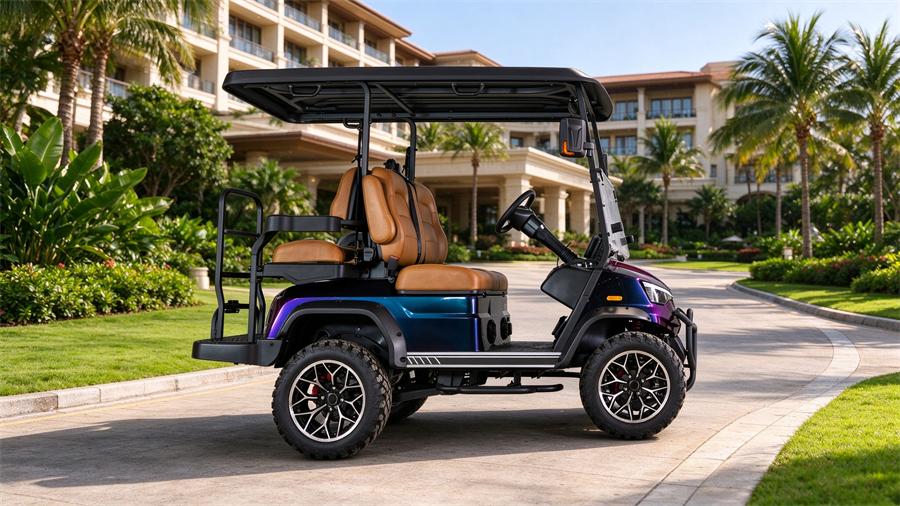
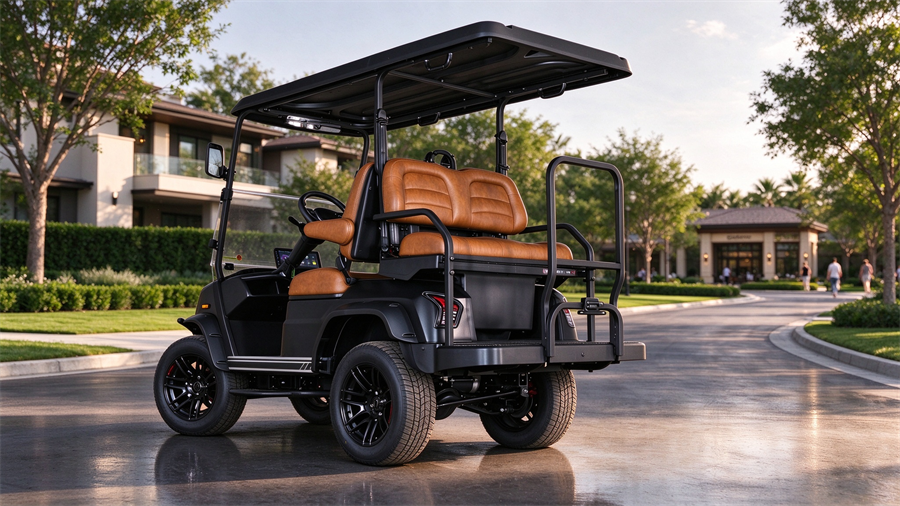
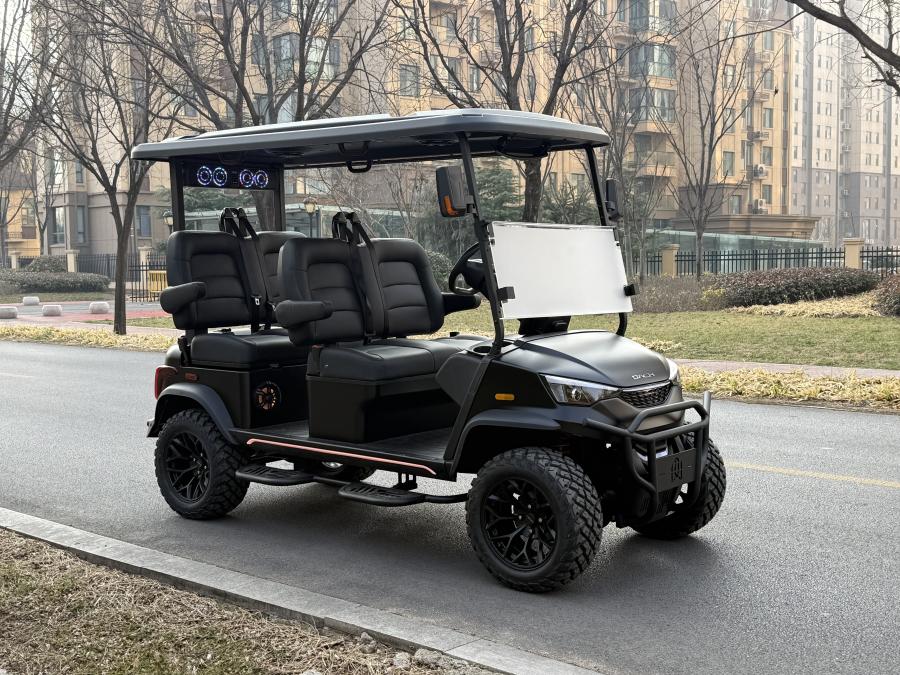
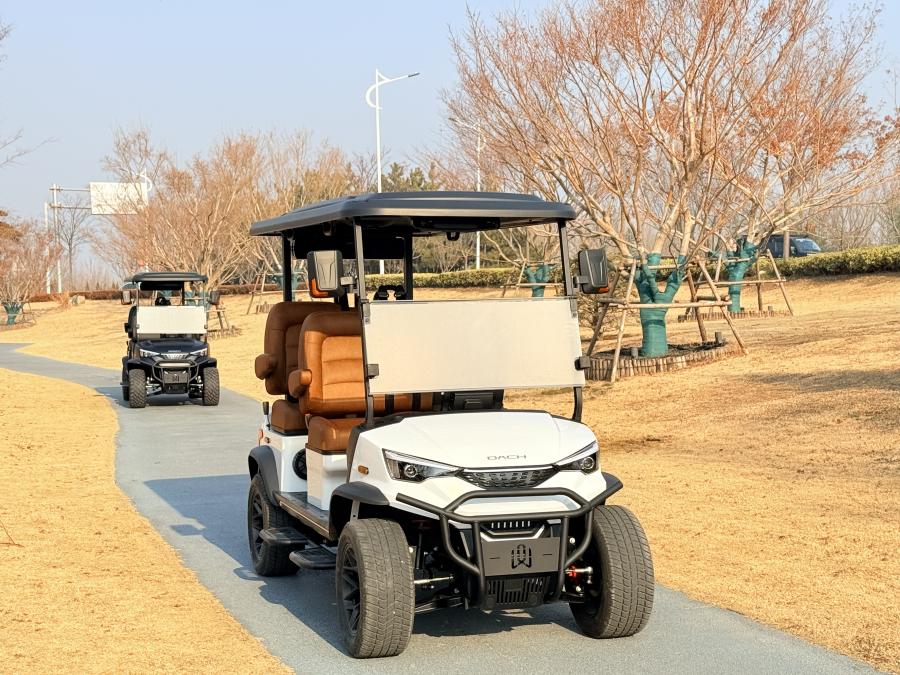
Four-seat golf carts are suitable for couples, small families, and individual guest transfers. Six-seat configurations are more practical for larger families, small tour groups, and busy shuttle routes.
A four-seat model may also provide greater flexibility in narrow pathways, while larger vehicles can reduce the number of trips required during peak transportation periods.
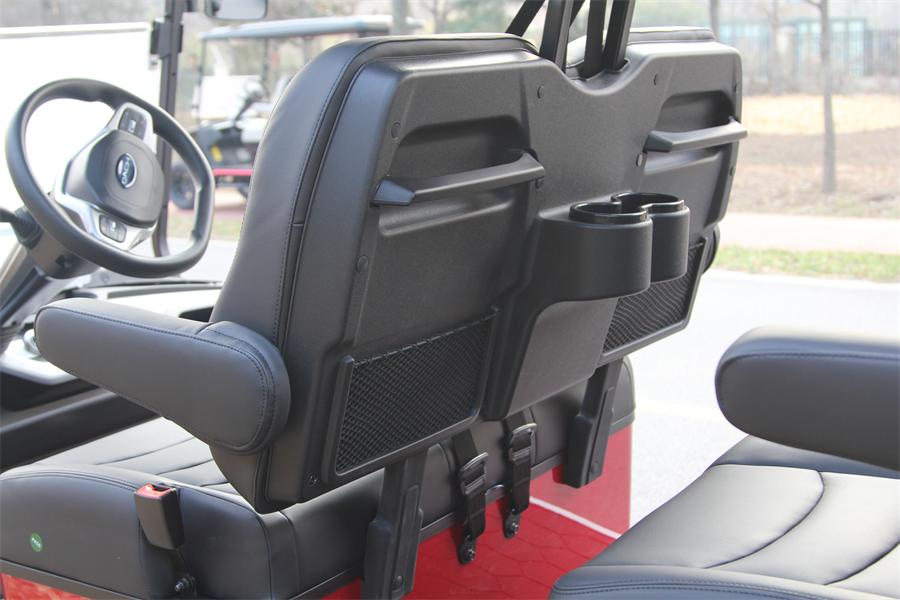
When evaluating passenger golf carts, operators should consider seat dimensions, entry and exit convenience, passenger restraints, weather protection, and luggage accommodation.
2.2 Luggage and Cargo Transportation
Luggage transportation is particularly important for luxury resorts, villa communities, and properties with dispersed accommodation buildings.
Guests arriving at reception may need their suitcases transferred to rooms located several hundred meters away. A dedicated cargo golf cart allows bell staff to transport luggage without occupying passenger shuttle vehicles.
Cargo vehicles can also support:
● Guest luggage and baggage transfer
● Fresh linen and housekeeping supplies
● Restaurant ingredients and beverage deliveries
● Pool towels and recreational equipment
● Maintenance tools and replacement parts
● Event equipment and hospitality supplies
A dedicated cargo vehicle is generally more efficient than using passenger carts for heavy or bulky items.
For example, the DACHI DC-H-F2 Cargo electric golf cart features a rear cargo box measuring 110 × 80 × 25 cm and a published loading capacity of 300 kg. Its specifications also include a 72V 105Ah lithium battery and a 6.3kW motor. These specifications make it a candidate for evaluating short-distance commercial transportation requirements, subject to confirmation of the actual permitted operating load and conditions.
2.3 Housekeeping and Facility Maintenance
Housekeeping and maintenance teams need frequent access to guest accommodation areas, public facilities, gardens, and service buildings.
Utility golf carts can help employees transport cleaning supplies, maintenance equipment, replacement materials, and other operational items.
For example, a resort with 100 villas spread across a large landscaped property may benefit from assigning dedicated utility vehicles to different operational departments.
This approach can reduce unnecessary vehicle sharing and improve the availability of transportation during busy periods.
2.4 Food and Beverage Delivery
Restaurants, pool bars, and beachside dining facilities often operate far from central kitchens or storage areas.
Cargo golf carts can support the movement of ingredients, packaged food, beverages, and catering equipment between designated service points.
For these applications, purchasing managers should evaluate cargo box dimensions, payload limits, weather protection, cleaning requirements, and ease of loading and unloading.
Food transportation procedures should also follow the property's applicable hygiene and temperature-control requirements.
2.5 Security and Property Patrol
Large tourism properties may require regular patrols across parking areas, landscaped grounds, recreational facilities, and internal access roads.
Passenger golf carts can provide security employees with convenient transportation while maintaining relatively low operating noise.
However, security vehicles should be configured according to patrol requirements, including lighting, communication equipment, storage space, and safe operating procedures.
|
Department |
Main Application |
Recommended Vehicle Type |
| Guest Services | Guest pickup and drop-off | 4-seat or 6-seat golf cart |
| Bell Services | Luggage transportation | Cargo golf cart |
| Housekeeping | Linen and cleaning supplies | Cargo utility golf cart |
| Food & Beverage | Food and beverage delivery | Cargo golf cart |
| Engineering | Tools and equipment transportation | Cargo utility golf cart |
| Security | Property patrol | Passenger golf cart |
| Recreation | Guest sightseeing and transfers | 4-seat or 6-seat golf cart |
3. How to Choose the Right Golf Cart for Your Hotel or Resort
Selecting the right golf cart requires matching vehicle configurations with transportation tasks. Purchasing decisions should be based on operational requirements rather than passenger capacity or appearance alone.
3.1 Two-Seat Cargo Golf Carts for Utility Operations
Cargo golf carts are designed primarily for transporting materials rather than multiple passengers.
They are suitable for housekeeping departments, maintenance teams, luggage transportation, and restaurant logistics.
Important purchasing considerations include:
● Rear cargo box dimensions and construction
● Maximum permitted payload
● Battery capacity and daily operating range
● Ground clearance and suspension
● Turning radius for narrow service routes
● Ease of cleaning and maintenance
The DACHI DC-H-F2 Cargo is an example of this configuration, with a dedicated rear cargo box and a published 300 kg loading capacity.
3.2 Four-Seat Golf Carts for Guest Transportation
Four-seat golf carts offer a balance between passenger capacity and maneuverability.
They are particularly useful for boutique hotels, villa resorts, and properties with multiple accommodation buildings.
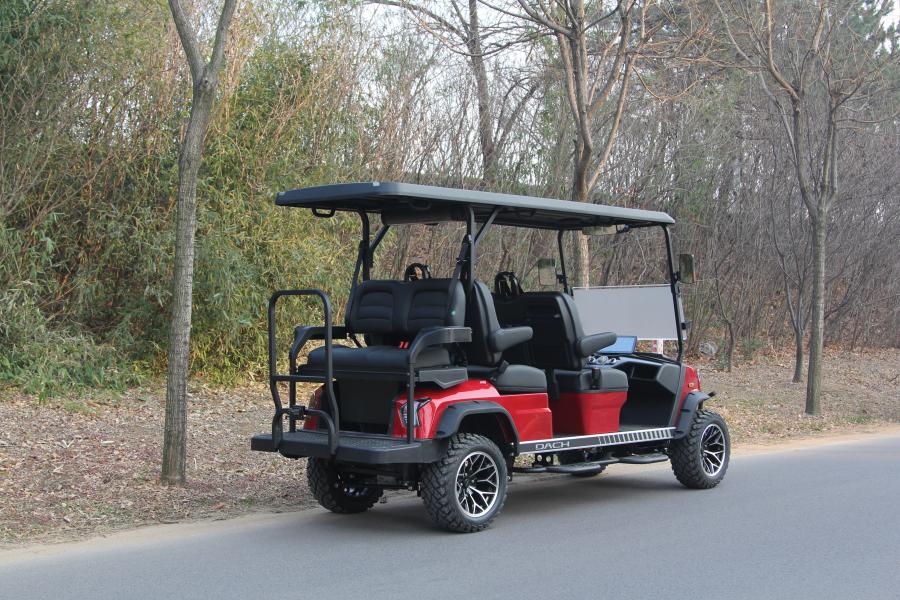
The DACHI DC-H-F4 four-passenger golf cart features a 72V 105Ah lithium iron phosphate battery, a 6.3kW AC motor, and a published driving range of at least 55.92 miles under a constant-speed test condition of 19 mph.
This model also lists a maximum load-carrying capacity of 758 lbs.
These specifications provide a starting point for fleet evaluation, although actual range will vary with passenger weight, terrain, speed, temperature, and driving patterns.
3.3 Multi-Seat Golf Carts for Large Resorts
Six-seat golf carts are useful for large resorts that regularly transport families, groups, and multiple guests.
A larger seating configuration can reduce the number of shuttle trips required, particularly during hotel check-in periods, conferences, and organized tourism activities.
The DACHI DC-H-F4+2 six-seat electric golf cart lists a 72V 105Ah LiFePO4 battery, a 6.3kW AC motor, and a maximum load capacity of approximately 1,137.58 lbs.
Its published driving range is at least 55.9 miles at a constant speed of 19 mph.
For buyers, an important consideration is whether the vehicle can accommodate all passengers comfortably while retaining sufficient capacity for any additional luggage.
3.4 Four-Passenger Golf Carts for Flexible Resort Mobility
Another option is a four-passenger golf cart with a different seating layout.
The DACHI DC-G-F2+2 is listed with a 72V 105Ah LiFePO4 battery, a 6.3kW AC motor, and a driving range of at least 55.9 miles at a constant 19 mph.
The model also has a published maximum load capacity of approximately 758 lbs.
This configuration can be considered for resorts that need flexible guest transportation without moving to a larger six-seat vehicle.
3.5 Comparing Golf Cart Configurations
|
Evaluation Factor |
Cargo Cart |
4-Seat Cart |
6-Seat Cart |
| Main purpose | Material transportation | Small-group transfers | Larger-group transfers |
| Typical users | Staff and service teams | Couples and families | Families and tour groups |
| Cargo capability | Dedicated cargo area | Limited, configuration-dependent | Limited, configuration-dependent |
| Maneuverability | Depends on dimensions | Generally more compact | Requires more turning space |
| Best application | Housekeeping and logistics | Guest transportation | Resort shuttle services |
| Main purchasing focus | Payload and box dimensions | Comfort and maneuverability | Seating and total load capacity |
The most practical fleet often combines two or more configurations instead of relying entirely on passenger vehicles.
4. Key Specifications to Evaluate When Purchasing Resort Golf Carts
Vehicle specifications determine whether a golf cart can perform reliably under real operating conditions. Procurement teams should evaluate the complete powertrain, chassis, braking system, and carrying capacity before selecting a supplier.
4.1 Battery Capacity and Driving Range
Battery capacity directly influences how long an electric golf cart can operate between charging sessions.
For example, a 72V 105Ah battery has a nominal energy capacity of approximately 7.56 kWh, calculated by multiplying voltage by amp-hour capacity.
However, nominal battery energy is not the same as usable energy. Actual operating range depends on battery chemistry, discharge limits, vehicle load, road conditions, driving speed, and temperature.
For hotel applications, buyers should ask suppliers to provide:
● Battery chemistry, such as LiFePO4 or other lithium-ion configurations
● Nominal and usable battery capacity
● Expected charging duration
● Battery management system specifications
● Battery warranty and replacement arrangements
● Range test conditions, including speed and vehicle load
A useful procurement practice is to conduct a loaded-route test using the actual resort operating environment rather than relying exclusively on manufacturer-advertised maximum range.
4.2 Motor Power and Climbing Ability
Motor output influences acceleration, load handling, and the vehicle's ability to operate on sloped routes.
Flat properties may not require the same performance characteristics as mountainous resorts or properties built along coastal hillsides.
For properties with slopes, buyers should evaluate:
● Motor rated power and controller specifications
● Maximum gradeability under load
● Acceleration with the intended passenger capacity
● Motor temperature under continuous operation
● Performance on wet or uneven surfaces
For example, DACHI's DC-H-F4 and DC-H-F4+2 models list a 6.3kW AC motor and a maximum gradeability of 30%.
This figure should be treated as a manufacturer-published specification, not a recommendation to operate at that gradient under every load or road condition. Buyers should request the relevant test conditions and verify safe operating limits.
4.3 Payload and Passenger Capacity
Payload capacity is particularly important for commercial golf cart fleets.
A vehicle carrying four adults, luggage, and additional equipment may approach its permitted load limit much faster than expected.
Purchasing managers should distinguish between:
● Passenger seating capacity
● Maximum payload
● Gross vehicle weight rating
● Cargo box capacity
● Manufacturer-defined maximum load
● These figures are not interchangeable.
Before ordering, confirm whether the published maximum load includes occupants and luggage. Never assume that a vehicle can carry its full advertised payload in addition to its maximum passenger capacity.
4.4 Braking, Suspension, and Turning Radius
Safety and maneuverability are essential when golf carts operate alongside pedestrians.
Resort pathways often include narrow corners, pedestrian crossings, ramps, landscaping, and changing surface conditions.
Important specifications include:
|
Component |
What Buyers Should Evaluate |
Why It Matters |
| Braking system | Hydraulic brakes, parking brake, braking performance | Safe stopping under load |
| Suspension | Independent suspension and shock absorbers | Ride comfort on uneven surfaces |
| Turning radius | Minimum turning radius | Navigation through narrow pathways |
| Ground clearance | Clearance under the vehicle | Uneven roads and speed bumps |
| Tires | Tire dimensions and tread pattern | Traction and surface compatibility |
| Seat belts | Passenger restraint configuration | Occupant protection |
| Lighting | Headlights, brake lights, turn signals | Visibility and operational safety |
For resort properties, a golf cart should be tested on representative routes before fleet-wide procurement.
4.5 Weather Resistance and Material Durability
Coastal resorts, tropical hotels, and properties with outdoor operating environments face additional durability challenges.
Salt air, humidity, UV exposure, rain, and frequent washing can affect vehicle components over time.
Procurement teams should evaluate:
● Frame and body corrosion resistance
● Electrical connector protection
● Battery enclosure protection
● Seat material and UV resistance
● Roof and windshield durability
● Availability of replacement components
A vehicle designed for occasional recreational use may not necessarily be suitable for continuous commercial operations.
5. How to Plan an Efficient Golf Cart Fleet for Large Tourism Properties
Fleet planning should begin with transportation demand rather than a predetermined number of vehicles.
A hotel with 50 guest rooms and a compact layout may need a completely different fleet from a 500-room resort with multiple accommodation zones, restaurants, and recreational facilities.
5.1 Assess Property Size and Transportation Demand
The first step is to map the property's transportation network.
Identify:
1. Main guest transportation routes.
2. Distances between reception and accommodation buildings.
3. Housekeeping and maintenance service routes.
4. Restaurant and supply delivery routes.
5. Areas with steep gradients or restricted access.
6. Peak transportation periods, including check-in and check-out.
This assessment helps determine the number of vehicles, their configurations, and their operating schedules.
5.2 Calculate Daily Vehicle Utilization
Daily mileage is more useful than advertised maximum range when estimating fleet requirements.
For example, consider a hypothetical resort vehicle that operates for eight hours per day and completes 20 trips, with each trip covering 1.2 km.
Its daily travel distance would be:
20*1.2=24km
The vehicle should have sufficient usable battery capacity to complete this duty cycle, including reasonable energy reserves.
The calculation should also account for waiting time, passenger loading, acceleration, slopes, and peak-season demand.
5.3 Establish a Balanced Vehicle Mix
A mixed fleet allows different departments to use vehicles suited to their workloads.
The following example shows how a hypothetical 100-room resort could allocate golf carts across guest services and operational departments. The allocation is illustrative and should be adjusted to the property’s layout, transportation demand, and operating conditions.
Example: Golf Cart Fleet for a 100-Room Resort
Illustrative Fleet Allocation
| Department / Function | Recommended Vehicle Configuration | Quantity |
| Guest transportation | 4-seat and 6-seat passenger carts | 4 |
| Housekeeping and luggage | Cargo / utility golf carts | 3 |
| Maintenance and logistics | Cargo / utility golf carts | 2 |
| Operational backup | Vehicle configuration based on fleet needs | 1 |
| Illustrative total fleet |
10 vehicles |
Planning note: Actual fleet size should be determined through route mapping, peak demand, trip frequency, vehicle utilization, and charging requirements.
The advantage of this approach is that passenger vehicles remain available for guest services while cargo vehicles handle operational transportation.
5.4 Build a Practical Charging Schedule
Charging infrastructure should be planned alongside vehicle procurement.
A resort operating multiple shifts may need designated charging locations and a vehicle rotation schedule to avoid unnecessary downtime.
Consider the following operational measures:
● Establish designated charging areas.
● Schedule charging around daily vehicle utilization.
● Monitor battery state of charge.
● Avoid routinely operating vehicles until the battery is deeply discharged.
● Inspect charging cables, connectors, and electrical installations.
● Maintain sufficient charging capacity for the entire fleet.
Charging areas should be appropriately ventilated, protected from environmental exposure, and designed according to the battery manufacturer's requirements and applicable fire and electrical regulations.
5.5 Monitor Total Cost of Ownership
The initial purchase price is only one part of commercial fleet expenditure.
A better purchasing decision considers total cost of ownership (TCO), including:
|
Cost Category |
Key Considerations |
| Initial purchase | Vehicle price, accessories and customization |
| Energy | Electricity consumption and charging infrastructure |
| Maintenance | Tires, brakes, suspension and electrical components |
| Battery | Warranty, replacement and degradation |
| Downtime | Lost transportation capacity and service disruption |
| Spare parts | Availability, delivery time and inventory |
| Disposal | Battery recycling and vehicle end-of-life costs |
A vehicle with a lower purchase price may become more expensive if it requires frequent repairs or has limited parts availability.
6. Safety, Accessibility, and Maintenance Requirements
Commercial golf carts operate in environments where pedestrians, guests, and service employees frequently share the same pathways. Safety management must therefore be part of the fleet operating strategy.
6.1 Establish Clear Operating Rules
Hotels should develop written operating procedures covering:
● Authorized drivers and minimum driving qualifications
● Maximum operating speeds in pedestrian areas
● Passenger capacity and load restrictions
● Designated routes and restricted-access areas
● Parking and charging procedures
● Daily vehicle inspection requirements
● Accident reporting and emergency response
Operators should receive training on braking, reversing, turning, passenger loading, and safe driving around pedestrians.
6.2 Consider Accessibility Requirements
Accessibility deserves particular attention in hospitality environments.
Under the US Department of Justice's ADA guidance, golf carts can qualify as other power-driven mobility devices (OPDMDs). Businesses must assess whether such devices can be accommodated based on factors including size, weight, speed, pedestrian traffic, and facility characteristics. ADA Mobility Devices guidance.
Hotels should not assume that providing a standard golf cart automatically satisfies all accessibility requirements.
Accessible routes, wheelchair accommodation, alternative transportation arrangements, and the specific needs of guests with disabilities should be evaluated separately.
6.3 Understand Vehicle Classification and Local Regulations
Golf carts and low-speed vehicles are not necessarily subject to the same regulatory requirements.
In the United States, NHTSA defines a low-speed vehicle under federal regulations as a four-wheeled vehicle with a maximum speed greater than 20 mph but not greater than 25 mph, subject to additional classification requirements.
Federal low-speed vehicle requirements include specific safety equipment under FMVSS No. 500. See the NHTSA regulatory interpretation.
Hotels should confirm whether vehicles will operate exclusively on private property or use public roads, and obtain the appropriate documentation for the destination market.
6.4 Follow a Preventive Maintenance Schedule
Preventive maintenance helps reduce unexpected downtime and improve vehicle availability.
A practical starting schedule is shown below. Actual inspection intervals should follow the manufacturer's maintenance manual and operating conditions.
|
Frequency |
Recommended Inspection |
| Before each shift | Tires, brakes, lights, steering and visible damage |
| Weekly | Battery condition, charging connectors and fasteners |
| Monthly | Brake condition, suspension, tires and electrical connections |
| Quarterly | Comprehensive mechanical and electrical inspection |
| Annually | Full fleet performance review and battery health assessment |
Maintenance records should include vehicle identification, mileage, inspection results, repairs, battery condition, and service history.
This information helps fleet managers identify recurring problems and plan replacement budgets.
7. How to Choose a Reliable Golf Cart Manufacturer for Commercial Projects
Choosing a reliable golf cart manufacturer is an important procurement decision, particularly for hotels and resorts purchasing multiple vehicles.
A commercial fleet requires consistent product quality, technical support, replacement parts, and long-term maintenance arrangements.
Before placing an order, purchasing managers should evaluate the following factors.
7.1 Manufacturing Experience and Production Capacity
A supplier should demonstrate experience in electric vehicle manufacturing and commercial golf cart production.
Buyers should investigate:
● Manufacturing facilities and production capacity
● Quality control procedures
● OEM and ODM customization capabilities
● Export experience and international markets
● Product testing and quality documentation
Manufacturing capability is particularly important for large projects requiring multiple vehicles with consistent specifications.
7.2 Product Customization
Different resorts have different operational requirements.
Some properties prioritize passenger comfort and premium appearance, while others need cargo transportation, additional storage, or specialized accessories.
Customization options may include:
● Passenger seating configurations
● Cargo box dimensions and materials
● Roof and windshield configurations
● Battery and powertrain options
● Lighting and safety accessories
● Body colors and branding
● Additional storage and utility equipment
A manufacturer capable of offering multiple configurations can help hotels standardize their fleet while meeting different departmental requirements.
7.3 After-Sales Service and Spare Parts
After-sales support directly influences the long-term reliability of commercial vehicles.
Before purchasing, confirm:
1. Warranty coverage for the vehicle, motor, controller, and battery.
2. Availability of commonly replaced components.
3. Technical documentation and maintenance instructions.
4. Response times for technical support.
5. Spare-parts delivery arrangements in the destination country.
6. Availability of remote troubleshooting and distributor support.
For international buyers, these factors are especially important because transportation and replacement-part lead times can affect vehicle availability.
7.4 Why Consider DACHI for Hotel and Resort Golf Cart Projects?
DACHI provides different electric golf cart configurations that can be evaluated for hospitality transportation and commercial utility applications.
Its product range includes passenger golf carts and cargo-oriented models, allowing buyers to consider different vehicle configurations within a fleet.
For hotel operators, the key is to select models according to actual operational requirements rather than purchasing every vehicle with the same specifications.
Procurement teams can review the DACHI electric golf cart product range to compare available configurations and discuss project-specific requirements.
Conclusion: Build a Golf Cart Fleet Around Your Resort's Operational Needs
Golf cart solutions for hotels, resorts, and large tourism properties should be designed around the daily transportation requirements of each property.
Passenger golf carts help improve guest mobility, while cargo golf carts support housekeeping, luggage handling, food delivery, and maintenance operations. Combining different vehicle configurations can improve fleet utilization and reduce unnecessary transportation trips.
Before purchasing, hotel operators should evaluate battery capacity, driving range, passenger capacity, payload, terrain compatibility, safety equipment, charging infrastructure, and after-sales support.
A well-planned electric golf cart fleet is not simply a transportation investment. It is part of a broader hospitality operations strategy that supports guest convenience, employee productivity, and efficient property management.
For hotel owners, resort developers, and commercial fleet operators planning new transportation projects, comparing vehicle configurations and working with an experienced golf cart manufacturer are important steps toward building a reliable long-term solution.
Frequently Asked Questions
1. What type of golf cart is best for hotels and resorts?
The best golf cart depends on the property's transportation requirements. Four-seat and six-seat electric golf carts are suitable for guest transportation, while cargo golf carts are better for luggage, housekeeping supplies, food deliveries, and maintenance equipment. Large resorts often benefit from combining several configurations.
2. How many golf carts does a large resort need?
The required number depends on the number of guest rooms, property size, daily transportation demand, route distances, and peak operating periods. A practical approach is to map transportation routes, estimate daily trips, calculate vehicle utilization, and include backup capacity for maintenance and unexpected demand. There is no universal vehicle-to-room ratio suitable for every resort.
3. Are electric golf carts suitable for luxury hotels?
Yes. Electric golf carts can support guest transportation, luggage handling, and internal logistics in luxury hotels. Their relatively quiet operation and flexible seating configurations make them useful for properties that prioritize convenient transportation and a comfortable guest experience. Vehicle appearance, seating materials, weather protection, and ride quality should also be considered.
4. What is the difference between a passenger golf cart and a cargo golf cart?
A passenger golf cart is designed primarily to transport people and typically features multiple seats, passenger restraints, and an enclosed or open cabin configuration. A cargo golf cart prioritizes material transportation and generally features a rear cargo box or utility platform. Hotels should select the configuration according to the department's operational requirements.
5. How far can an electric golf cart travel on a single charge?
Driving range depends on battery capacity, vehicle weight, passenger load, terrain, speed, temperature, and driving conditions. Some commercial electric golf carts advertise ranges exceeding 50 miles under specified test conditions. However, hotels should request loaded-range test results and evaluate performance using their actual daily routes before purchasing.
6. Are lithium battery golf carts suitable for commercial resort operations?
Lithium battery golf carts can be suitable for high-frequency commercial applications because they offer advantages such as relatively high energy density, reduced routine battery maintenance, and flexible charging arrangements. Buyers should compare battery chemistry, usable capacity, battery management systems, charging time, warranty coverage, and replacement costs before selecting a battery configuration.
7. What should hotels look for when choosing a golf cart manufacturer?
Hotels should evaluate manufacturing experience, product quality, battery and motor specifications, customization capabilities, warranty terms, spare-parts availability, and technical support. For large commercial projects, buyers should also request product documentation, sample testing, pre-shipment inspections, and confirmation of compliance with destination-market regulations.
Post time: Nov-12-2026